Why Is the Profile Drawing Important When Ordering a Roll Forming Machine?
19 Nov
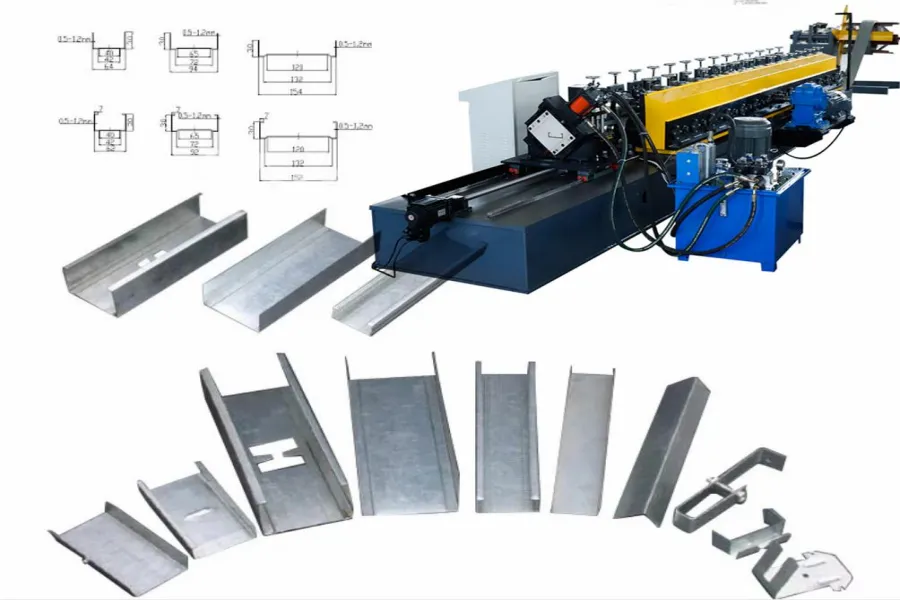
When purchasing a roll forming machine, many customers focus on the machine price, production speed, material thickness, and delivery time. However, one of the most important documents in the entire purchasing process is often overlooked: the profile drawing.
A profile drawing is more than a simple sketch of a steel product. It provides the dimensional and technical information that a roll forming machine manufacturer needs to design the forming rollers, determine the machine configuration, arrange punching stations, and ensure that the finished product meets the customer's requirements.
Whether you are purchasing a roofing panel machine, C purlin machine, Z purlin machine, metal stud and track machine, or another customized roll forming line, providing an accurate profile drawing can make the entire project more efficient and reliable.
So, why is the profile drawing so important when ordering a roll forming machine?
1. It Helps the Manufacturer Understand Your Exact Product
Different customers may use the same product name but require completely different dimensions.
For example, C purlins are widely used in steel structure buildings, but their web heights, flange widths, lip dimensions, and material thicknesses can vary significantly depending on regional standards and project requirements.
The same situation applies to roofing panels, wall panels, metal studs, tracks, and other steel profiles.
A profile drawing allows the manufacturer to clearly understand the shape and dimensions of the product you want to produce. Instead of relying on assumptions or general product descriptions, the machine design can be based on your actual specifications.
This is especially important for customized profiles that do not follow standard dimensions.
2. It Determines the Design of the Forming Rollers
The forming rollers are among the most important components of a roll forming machine. Their shape, arrangement, and forming sequence directly affect how the flat metal strip gradually becomes the required finished profile.
Based on the profile drawing, the manufacturer can design the roller tooling and determine how many forming stations may be needed.
Different profiles require different roller designs. Even small changes in flange width, bending angle, lip dimensions, or profile height may affect the roller design and forming process.
Without a clear profile drawing, it is difficult to accurately design the forming rollers. Incorrect roller design may lead to problems such as dimensional deviations, poor forming quality, surface scratches, or difficulties during production.
Providing the profile drawing at the beginning of the project helps the manufacturer develop a forming solution that matches your product requirements.
3. It Helps Confirm the Machine Configuration
The profile drawing is not only used for roller design. It also helps determine the overall configuration of the roll forming machine.
For example, the manufacturer may need to evaluate:
-
Number of forming stations
-
Machine frame structure
-
Roller and shaft specifications
-
Feeding and guiding system
-
Cutting method
-
Hydraulic system
-
Motor power
-
Whether additional punching stations are required
A simple roofing panel may require a different machine configuration from a structural C purlin with multiple holes.
If the profile requires complex bends, special edges, reinforcing ribs, or specific dimensional tolerances, these details may influence the machine design.
The more complete the drawing, the more accurately the manufacturer can recommend the appropriate machine configuration.
4. It Helps Calculate the Material Width
Material width is an important factor in roll forming production.
Before a flat steel coil enters the roll forming machine, the material width must be determined according to the finished profile geometry and forming process.
The profile drawing provides the dimensions needed to evaluate the approximate developed width of the material. However, the final coil width may also depend on bending allowances, material thickness, bend radii, forming method, and the manufacturer's tooling design.
If the material width is calculated incorrectly, it may result in excessive material consumption, incorrect profile dimensions, or difficulties during forming.
With a complete profile drawing, the manufacturer can evaluate the material width more accurately and help the customer confirm suitable coil specifications before production.
5. It Helps Design Punching Positions and Cutting Requirements
Many roll formed profiles require holes, slots, notches, or other customized features.
For example, C purlins and Z purlins may require web holes for bolt connections or installation. Metal studs may require service holes for electrical wiring and plumbing. Other profiles may require special openings for assembly or fastening.
The profile drawing should clearly indicate the location, size, quantity, and shape of these holes or openings.
If punching is required, the manufacturer needs to understand whether the punching operation should be completed before roll forming, during the forming process, or through a separate station, depending on the profile and machine design.
The drawing also helps confirm cutting requirements, including finished length, cutting tolerance, and whether the product requires special end shapes.
Providing these details early can help avoid design changes after machine manufacturing has already started.
6. It Reduces Misunderstandings and Costly Modifications
Ordering a customized roll forming machine involves several stages, including technical confirmation, machine design, manufacturing, assembly, testing, and shipment.
If the product dimensions are unclear at the beginning, misunderstandings may occur between the buyer and manufacturer.
For example, the customer may expect a certain flange width or lip dimension, while the manufacturer interprets the requirements differently. Even a small dimensional difference can be important when the finished profile needs to fit with other structural components.
A confirmed profile drawing provides a common technical reference for both parties.
It helps reduce unnecessary communication, prevents avoidable design changes, and lowers the risk of modifications during manufacturing.
In many cases, spending more time confirming the profile drawing before placing an order can save much more time and money later.
7. It Helps Verify Finished Product Quality
A profile drawing is also an important reference for machine testing and quality inspection.
After the roll forming machine is assembled, the manufacturer can use the confirmed drawing to check the finished profiles produced during testing.
The inspection may include:
-
Overall profile height
-
Web width
-
Flange dimensions
-
Lip dimensions
-
Bending angles
-
Hole positions and dimensions
-
Finished length
-
Profile symmetry and shape
The exact inspection requirements depend on the product and the customer's specifications.
If dimensional tolerances are important, they should be clearly indicated on the drawing or in the technical specification. This allows both the manufacturer and customer to establish clear expectations regarding the finished product.
A detailed drawing helps make machine testing more meaningful because the results can be evaluated against specific requirements rather than general expectations.
8. It Makes Customized Roll Forming Solutions Possible
Not every customer produces standard profiles available in the market.
Some manufacturers have their own profile designs, regional building standards, special connection systems, or unique product requirements. In these situations, a customized roll forming machine may be necessary.
A detailed profile drawing gives the machine manufacturer the information needed to evaluate whether the product can be produced through roll forming and how the machine should be designed.
Based on the drawing, the manufacturer can discuss possible forming methods, roller designs, punching solutions, cutting systems, and machine configurations.
This makes it easier to develop a machine that matches the customer's actual production needs rather than offering a standard machine that may not be suitable.
9. What Should Be Included in a Profile Drawing?
To help a roll forming machine manufacturer evaluate your project, the profile drawing should ideally include the following information:
Profile Dimensions
Clearly indicate all important dimensions, including overall width, height, flange width, lip dimensions, angles, and other geometric details.
Material Thickness
Specify the required material thickness or thickness range.
Material Type
Indicate whether the material is galvanized steel, cold-rolled steel, pre-painted steel, aluminum, or another material.
Hole and Punching Details
If the profile requires holes, provide their dimensions, shape, quantity, spacing, and location.
Bending Angles and Special Features
Clearly indicate special bends, curved sections, reinforcing ribs, embossing, or other features.
Dimensional Tolerances
If certain dimensions must meet specific tolerances, mark them clearly on the drawing.
Finished Length
If the machine needs to cut profiles to specific lengths, provide the required length range and cutting accuracy.
A PDF drawing is usually convenient for technical communication. CAD files such as DWG or DXF can also be useful when available, especially for customized profiles.
If you do not have a professional drawing, you can also send a clear photo of the finished product, a physical sample, or a hand-drawn sketch with accurate measurements. The manufacturer may then help you prepare or confirm the technical drawing.
10. How to Get a More Accurate Roll Forming Machine Quotation
When requesting a quotation, providing only the machine name may not be sufficient to determine the exact configuration and price.
For example, the price of a C purlin roll forming machine may vary depending on the profile dimensions, material thickness, punching requirements, automatic width adjustment, cutting system, stacking method, and production speed.
To receive a more accurate quotation, it is helpful to provide the following information:
-
Profile drawing
-
Material type
-
Material thickness
-
Required production speed
-
Finished product length
-
Punching requirements
-
Required automation functions
-
Electrical requirements
-
Estimated production volume
With these details, the manufacturer can evaluate the project more efficiently and recommend a suitable machine solution.
Work with Sussman Machinery on Your Custom Roll Forming Project
Sussman Machinery specializes in roll forming machine manufacturing and customized production solutions for customers worldwide.
Our machines are designed for various metal profiles, including roofing panels, wall panels, C purlins, Z purlins, CZ interchangeable profiles, light gauge steel framing components, metal studs and tracks, roller shutter door slats, and other customized products.
We understand that every project may have different profile dimensions, material requirements, production targets, and automation needs.
A profile drawing allows our technical team to better understand your requirements and evaluate the appropriate machine design, forming rollers, punching system, cutting method, and production line configuration.
If you are planning to purchase a roll forming machine, you are welcome to send us your profile drawing for evaluation. Our team can review your requirements and provide a suitable machine solution for your project.
Conclusion
A profile drawing is one of the most important documents when ordering a roll forming machine. It helps the manufacturer understand the product, design the forming rollers, determine machine configuration, calculate material width, arrange punching and cutting systems, and verify finished product quality.
Providing an accurate drawing before placing an order can reduce misunderstandings, avoid unnecessary modifications, improve quotation accuracy, and make the machine manufacturing process more efficient.
If you have a profile drawing, sample, or product sketch, sharing it with your roll forming machine manufacturer is the best starting point for developing a suitable production solution.
At Sussman Machinery, we are ready to help you turn your profile requirements into a practical roll forming production line.

Recent Posts

October 26, 2016
The Most Successful Engineering Contractor