
How Steel Grade and Yield Strength Affect Roll Forming Performance
29 Oct
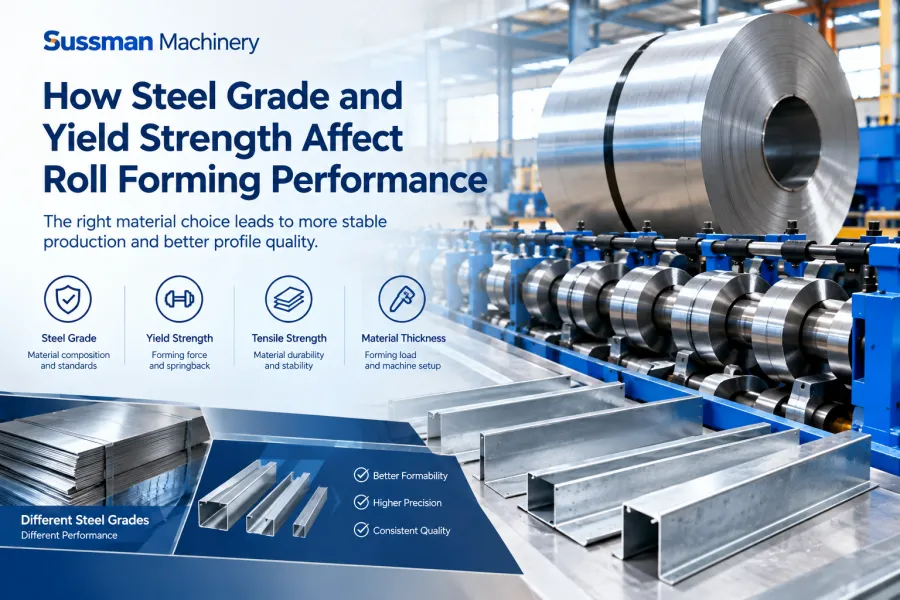
In roll forming production, selecting the right steel material is just as important as choosing suitable machinery. Steel grade, yield strength, tensile strength, and material thickness can all influence the forming process, final profile dimensions, and overall production stability.
For manufacturers producing metal roofing panels, steel framing components, purlins, and other cold-formed profiles, understanding these material properties helps improve production planning and achieve more consistent results.
1. Understanding Steel Grade and Mechanical Properties
Steel grade identifies a material's specified properties and composition according to a relevant standard. However, two steel coils with similar nominal thicknesses may behave differently during roll forming because their mechanical properties can vary.
Three important factors should be considered:
-
Yield strength: The stress at which steel begins to undergo permanent deformation.
-
Tensile strength: The maximum tensile stress the material can withstand before failure.
-
Material thickness: A key factor affecting forming loads, bending geometry, and machine configuration.
These properties should be evaluated together rather than relying on thickness alone when planning a roll forming project.
2. How Yield Strength Influences Roll Forming
During roll forming, a flat steel strip passes through successive roller stations. Each station gradually bends the material until it reaches the required cross-sectional shape.
Higher-yield-strength steel generally requires greater forming forces and may exhibit more pronounced springback after bending. Springback occurs when the material partially returns toward its original shape after the forming load is removed.
To compensate for this behavior, the roller tooling and forming sequence may need to be adjusted according to the material specifications and target profile geometry.
The appropriate number of forming stations, roller design, shaft strength, and drive capacity also depend on the specific material and profile requirements.
3. Why Material Consistency Matters
Even when steel coils have the same nominal grade and thickness, variations in mechanical properties can affect the finished product.
Changes in yield strength may influence flange angles, profile dimensions, and the consistency of formed sections. Differences in material thickness can also affect the forming load and dimensional results.
For this reason, buyers should provide accurate material specifications when requesting a customized roll forming machine.
Where possible, material certificates and representative steel samples can help equipment manufacturers better understand the intended production conditions.
4. Matching the Machine to the Material
A roll forming machine should be designed around the actual production requirements, including:
-
Steel grade and mechanical properties
-
Minimum and maximum material thickness
-
Required profile dimensions
-
Bending angles and corner radii
-
Required production speed
-
Dimensional tolerances
Providing this information at the beginning of a project helps establish a more appropriate machine configuration and reduces uncertainty during commissioning.
Conclusion
Steel material selection is an important part of successful roll forming production. Understanding yield strength, tensile strength, thickness, and material consistency allows manufacturers to plan the forming process more effectively.
At Sussman Machinery, we work with customers to understand their material specifications and profile requirements before discussing suitable roll forming solutions.
Contact Sussman Machinery with your profile drawings and steel specifications to discuss your project requirements.

Recent Posts

October 26, 2016
The Most Successful Engineering Contractor