C Purlins vs. Z Purlins: Applications in Steel Building Structures
29 Oct
Cold-formed steel purlins are widely used in industrial buildings, warehouses, workshops, and other steel construction projects. Among the most common profiles are C purlins and Z purlins.
Although these two profiles may look similar in terms of their general purpose, their cross-sectional shapes and connection arrangements create different possibilities for structural design.
For steel building manufacturers and metal fabrication companies, understanding the differences between C and Z purlins is useful when planning profile production and selecting suitable roll forming equipment.
1. What Are C Purlins?
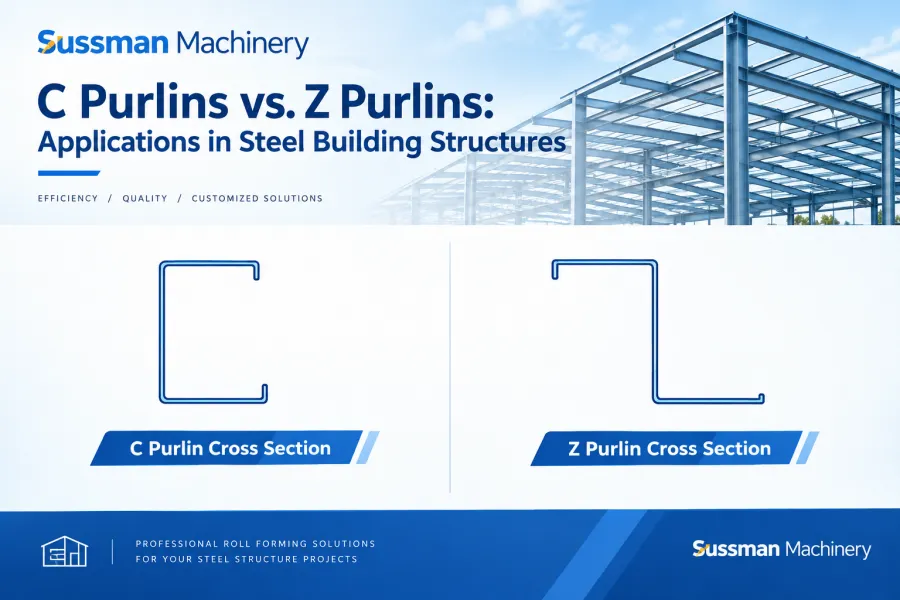
C purlins have a C-shaped cross-section, typically consisting of a web, two flanges, and inward-facing lips.
They are commonly used as secondary structural members in steel buildings, supporting roof or wall cladding and transferring loads to the primary structural frame.
Depending on the engineering design, C purlins may be used for roof structures, wall girts, framing around openings, and other applications.
Their geometry can also make them suitable for projects where individual sections and particular connection arrangements are required.
2. What Are Z Purlins?
Z purlins have a Z-shaped cross-section, with flanges extending in opposite directions.
One important feature of this geometry is that adjacent sections can overlap at supports when the structural design allows it. This makes Z purlins useful in certain multi-span roofing arrangements.
Their suitability depends on factors such as span length, loading conditions, support positions, bracing, and connection design.
Neither C purlins nor Z purlins are universally better. The appropriate profile must be determined by the requirements of the building project.
3. Key Differences Between C and Z Purlins
Cross-sectional geometry: C purlins have a channel-like shape, while Z purlins have oppositely oriented flanges.
Connection arrangements: Z purlins can accommodate lapped connections in suitable structural layouts. C purlins may be preferred for other framing configurations.
Project requirements: The choice depends on the structural design, including span, loads, support conditions, and connections.
Production requirements: Each profile requires appropriate roller tooling and forming parameters. The machine configuration depends on the profile dimensions, material thickness, steel properties, and required output.
4. What Should Buyers Consider When Producing C and Z Purlins?
Before investing in purlin roll forming equipment, manufacturers should establish the intended product range.
Important information includes:
-
Profile drawings and cross-sectional dimensions
-
Minimum and maximum material thickness
-
Steel grade and mechanical properties
-
Required punching patterns and hole positions
-
Cut lengths and dimensional tolerances
-
Production volume and changeover requirements
If both C and Z profiles are required, buyers should confirm whether they need separate production configurations or a machine specifically engineered for the intended range.
The feasibility of producing multiple profiles on one machine depends on the actual tooling design and machine specifications.
Conclusion
C purlins and Z purlins both play important roles in modern steel construction. Their different geometries provide options for different structural layouts, while the final selection must follow the project's engineering requirements.
For manufacturers planning to produce these profiles, a clear understanding of product dimensions, steel specifications, and production needs is the starting point for selecting suitable roll forming equipment.
Sussman Machinery welcomes inquiries from customers seeking roll forming solutions for C purlins, Z purlins, and other cold-formed steel profiles.
Contact us with your profile drawings and production requirements to discuss a suitable configuration.

Recent Posts

October 26, 2016
The Most Successful Engineering Contractor